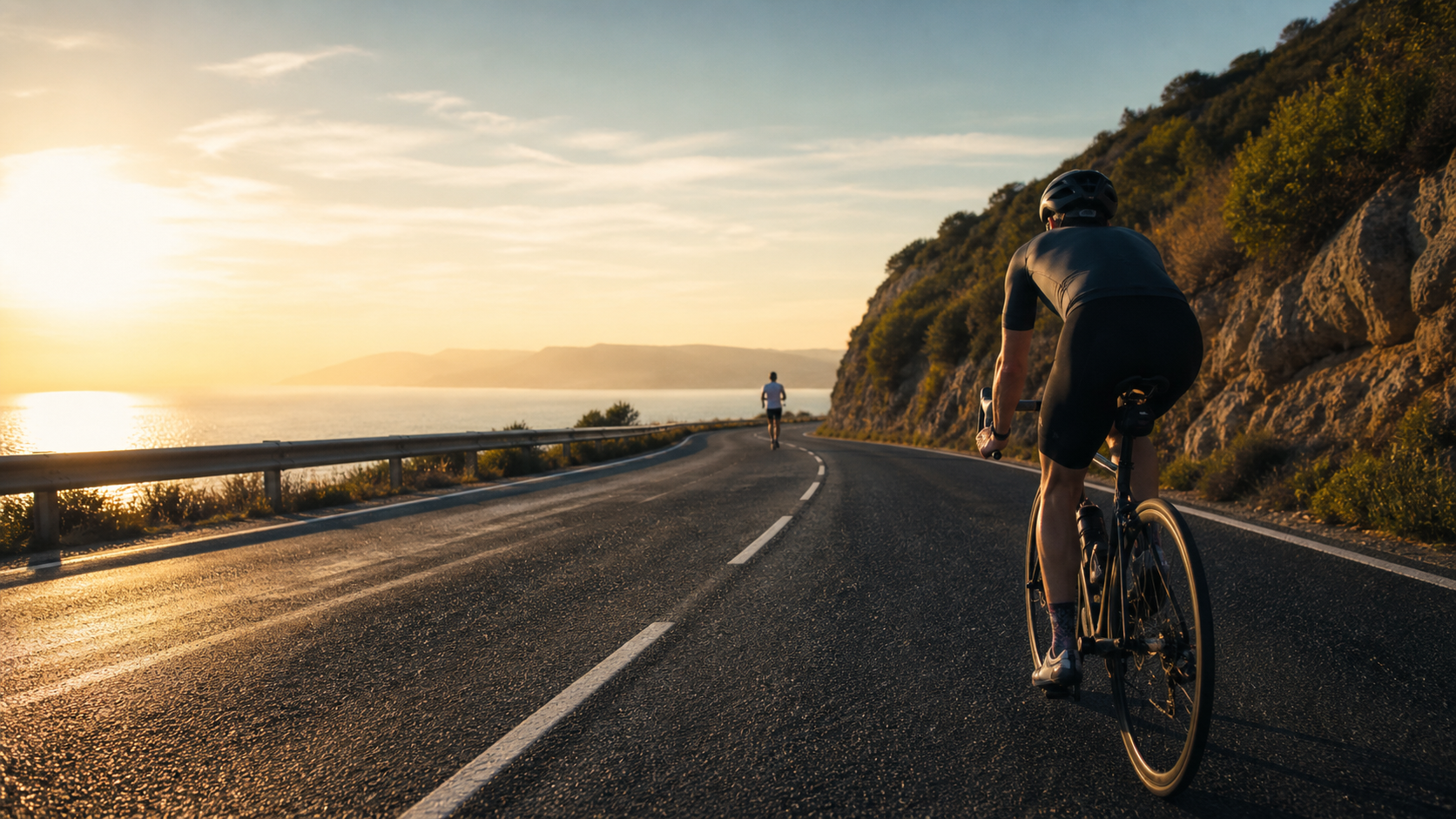
As I explained in the first article on my blog, one of my passions, the one that takes quite a lot of time and energy, but also gives me a lot of satisfaction, is triathlon.
Triathlon means, in sequence: swimming, cycling, running.
It is fun also because you move across three quite different disciplines. Training rarely becomes boring, because it is unusual to train in the same discipline two days in a row. One day you may be in the swimming pool, the next day on the bike trainer or outside on the road, and the day after that running, maybe on the track at the Stadio di Caracalla in Rome.
It also requires a bit of courage. In races, the swim is almost always in open water, often in the sea, and there you have to manage weather conditions, waves, orientation, and many other people swimming in front of you, behind you and next to you. On the bike, in some downhill sections, speed can easily reach and exceed 50 km/h. You feel the adrenaline, and also a little fear. Which, in my opinion, is never a bad thing.
Running, on the other hand, has always been one of my sports. In my work, every time I have travelled, my running shoes have always been in my suitcase. I can say I have run in more than 20 countries, across Europe, the United States and the Middle East.
Finally, apart from sprint distances, which I personally do not love, triathlon is an endurance sport. For amateurs like me, the effort becomes significant already from the Olympic distance: 1,500 meters of swimming, 40 km on the bike and 10 km of running. For many of us, that means being in a race for around three hours. Longer than a half marathon, which I usually run in about 1 hour and 45 minutes.
The 70.3 Distance
For someone like me, relatively “young” in terms of experience and enthusiasm, unfortunately not in terms of age, perhaps the most beautiful distance is the 70.3, which comes from the Ironman circuit.
70.3 indicates the total distance in miles. Converted into kilometres, it means 1.9 km of swimming, 90 km on the bike and a half marathon, 21.1 km of running.
Definitely endurance.
A good amateur may take around six hours. A professional athlete can go down to around three and a half hours. But above all, the real challenge is starting a half marathon, maybe under the summer sun, after already swimming almost two kilometres and riding 90 km, often trying to maintain an average speed close to 30 km/h.
My Experience So Far
I want to be honest: so far, I have completed only one 70.3. In Cervia, last year.
I liked it, and I will do it again this September.
It took me a little longer than expected, maybe I will tell that story in another article, also because of an important mistake that almost compromised the bike leg. But the support of my team, Team Nexus Training, and of the people who follow me in my preparation, helped me not to give up.
In the end, I reached the finish line. And a kind young woman put the finisher medal around my neck.
Having said that, and forgive the long introduction, the question is: what does it really take to finish a 70.3?
What kind of training does a person do when, like me, he already has a demanding job, one that requires a good amount of energy, focus and time?
Where It Starts
Well, do not worry: if I can do it, many people can do it. Of course, if they really want to and if they build the path gradually.
Preparation starts from a base built on shorter distances. In my case, before triathlon there was running. I ran for about ten years, completing three marathons. That certainly helped me.
I am followed by Mauro, a FITRI coach and president of the team. So the training is not left to chance. It is planned every week, taking into account my condition, my commitments and my goals.
It is a progression built over time, designed to develop the endurance and aerobic base needed not to stop after three hours.
And I have to say that, especially in spring and summer, the training sessions, although demanding, are also enjoyable. In winter, waking up at six in the morning to go to the swimming pool is not exactly my favourite thing. But, almost always, I manage to do it.
How Much Do You Train?
I am describing my own experience, what I do. Of course, this is not the only way to prepare for a 70.3.
In my case, the training volume is practically daily.
During the week, training sessions usually last one hour, at most one hour and a half. I alternate swimming, cycling, often on the indoor trainer at home, and running, sometimes on the track at the Stadio di Caracalla.
On weekends, the longer sessions arrive. The bike ride can last from two to three and a half hours. The run can be around 15 to 20 km.
Then there are brick sessions, which are also among the most interesting and enjoyable workouts. Usually this means bike plus run, sometimes repeated in blocks, to train both mind and legs for the sensations you feel when you get off the bike and have to start running.
It is not a trivial sensation. Your legs have just spent a long time rotating at 80 to 90 pedal strokes per minute, and suddenly they have to change movement, rhythm and impact. And they have to do it knowing that there is still a half marathon ahead, to be run at a sustainable pace for a little less than two hours.
Nutrition Is Trained Too
A sporting effort that lasts so long, six hours or more for many amateurs, obviously requires a lot of attention to nutrition as well.
On this aspect I am followed by Adriano, a nutritionist and athlete, who helps me define a strategy suited to my needs.
A race of this duration is not prepared only with swimming, cycling and running. It also requires nutritional preparation over several months and a clear strategy to follow during the race.
I will not go too much into the details, also because every athlete is different and needs a personalised approach. But the principle is simple: during the race you need to drink and fuel regularly, to avoid dehydration and to avoid running out of energy before the finish line.
In my case, being quite light helps me especially in the run. But that does not mean you can improvise.
During the bike leg, which is the longest and the one where it is easier to take in nutrition, you need to consume a significant amount of carbohydrates, often in the range of 80 to 100 grams per hour, together with adequate hydration.
Said like this, it sounds like a formula from a table. In reality, it is a bit like saying: every hour you have to “eat” a big plate of rice while you are pedalling. Try to imagine it, and you immediately understand that it is not so simple.
Of course, you do not eat rice during the race. You use gels, bars and specific products. But the stomach and the gut have to be trained too, just like the legs. Otherwise, the risk is cramps, digestive problems oreven more unpleasant issues, exactly when you need to stay focused on the race.
Training Well, Not Just Training a Lot
For people my age, even if in my head I still feel like I am twenty, although those years passed a while ago, training sessions are often interval-based.
Running, for example, is almost never just long and slow. Often there are different stimuli, designed to maintain an efficient running form, some speed and a bit of freshness, even when the legs are tired.
On the bike, outdoors, there are the famous climbs. Around Rome there are some quite tough ones. Together with indoor trainer sessions, they help develop the power needed to sustain the bike leg in the race without arriving at the run completely empty.
Swimming is also often interval-based. In my case, swimming is not my strongest point, and I am being generous in saying that, so I always try to improve my technique. Above all, I try to build a more economical swim and avoid wasting unnecessary energy already in the first leg.
So, What Does It Mean to Prepare for a 70.3?
Preparing for a 70.3 does not only mean training a lot.
It means learning how to organise your time, listen to your body, accept fatigue and build confidence week after week. It means having a plan, but also knowing how to adapt it. It means training three different disciplines, but above all learning how to put them together.
And it also means discovering that, inside a normal life, with work, commitments, family and full days, you can still create space for a long, demanding and beautiful challenge.
For me, today, preparing for a 70.3 means this: arriving at the start line knowing that I have done the work, with respect for the distance, a bit of adrenaline and the desire to see what happens when, after 1,900 meters of swimming and 90 km on the bike, you finally start running towards the finish line.


